
DeKalb City Directory Holdings
DeKalb County does not have one continuous countywide directory run. The verified shelf begins with directories dating to 1928 at the Decatur Library. Some volumes are print and others are microfilm. The DeKalb History Center separately identifies a 1928-29 Decatur volume whose reach includes Avondale Estates, Emory University, and Scottdale. That wider coverage matters because the title alone understates its geography.
| Historical collection | Date span | Repository | How to use it |
|---|---|---|---|
| DeKalb and Decatur city directories | Dating to 1928; individual years vary | Decatur Library Reference Desk | Print and microfilm; some in-library only |
| Decatur city directory | 1928-1929 | DeKalb History Center | Appointment and in-person research |
| Georgia census microfilm | 1820-1920 | Decatur Library | In-library film |
| Community newspapers and newsletters | Incomplete local runs | Library and History Center | Database, film, or archive appointment |
| County record books | Chiefly before 1900 on film | Georgia Archives and FamilySearch | Free archive browse; account may be needed |
Record the title page, volume year, publisher if shown, page and column for every hit. A missing year is not proof that a person left DeKalb County. The volume may be absent, the household may have declined a listing, or the name may sit under a different spelling.
Geography also changes what belongs on the shelf. DeKalb County contains Decatur, Avondale Estates, Brookhaven, Chamblee, Clarkston, Doraville, Dunwoody, Lithonia, Stonecrest, Stone Mountain, Tucker, and parts of Atlanta, among other places. A postal city does not always identify the government that kept a record. Preserve the city wording printed in the directory, then compare it with period maps and county land descriptions. For early land work, the 15th, 16th, and 18th districts appear often in plats and cemetery descriptions.
DeKalb Directory Desk Access
The primary shelf route is the Decatur Library local history and genealogy collection at 215 Sycamore Street. Ask at the second-floor Reference Desk for both print and microfilm city directory formats. A catalog keyword result may not reflect each desk-held volume, so staff help is part of the search channel.
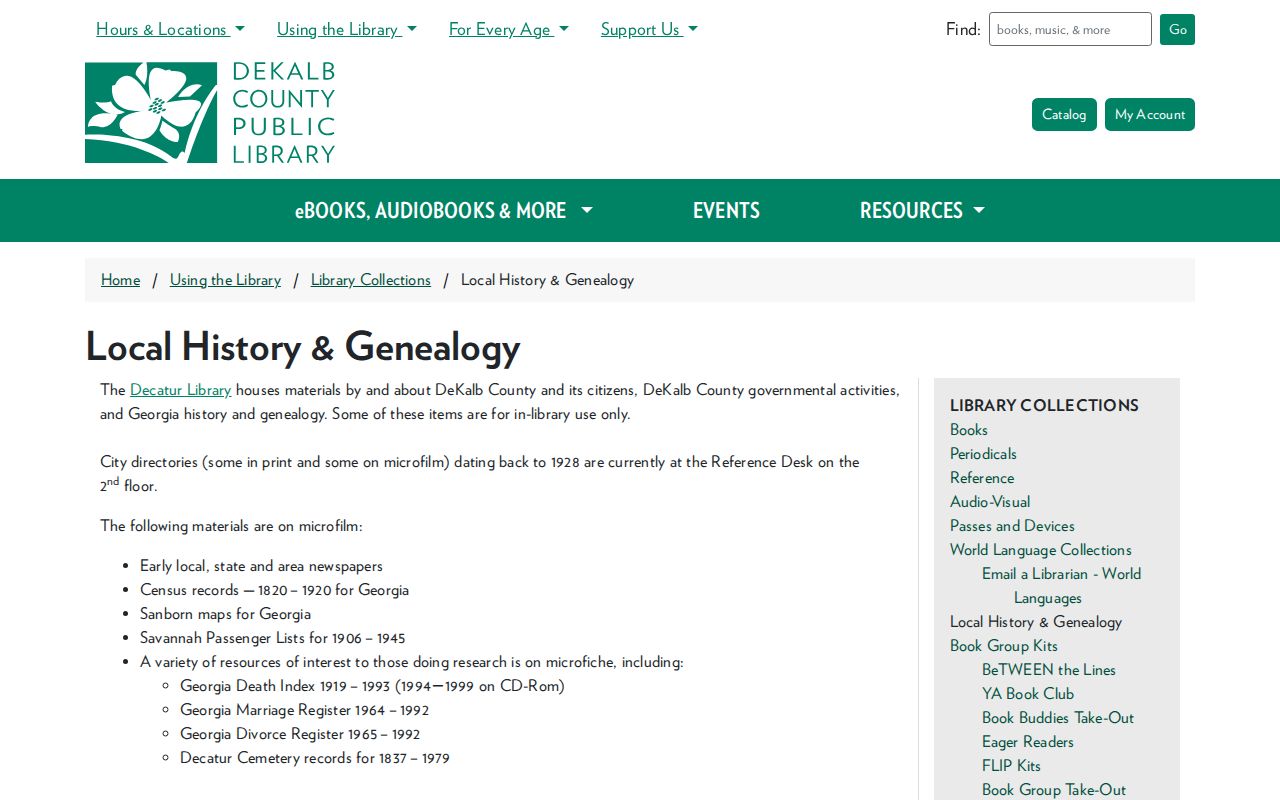
The library description confirms the 1928 start and shows why an in-person check can reach material that is not fully searchable online. Before traveling, ask which years are available, whether a reverse street section exists, and which format holds each year.
The same desk holds Georgia census film, Sanborn maps, local newspapers, death and marriage indexes, and cemetery microfiche. These sources help test a directory match without treating one brief entry as a full identity record.
When calling ahead, give the Reference Desk a narrow request: a surname, likely year range, and known street if one exists. Ask whether the desired year is in print or on film. For microfilm, record the reel label as well as the page. The local-history collection includes the Georgia Death Index for 1919-1993 and a 1994-1999 CD-ROM, the Georgia Marriage Register for 1964-1992, the Georgia Divorce Register for 1965-1992, and Decatur Cemetery records for 1837-1979. Those are index leads, not certified copies.
Decode DeKalb City Directory Entries
A DeKalb County city directory entry is compact. Read the volume's own key before expanding any mark, since abbreviations and ownership symbols vary by publisher. The 1928-29 volume has not been exposed as an official online page image, so its exact glyphs and publisher must be checked in the physical book.
| Personal name | Surname, given name or initial; a spouse may appear in parentheses. |
|---|---|
| Work detail | An occupation or shortened employer name may distinguish two people. |
| Street address | The printed house number and period street spelling anchor the household. |
| Residence mark | Letters such as h or r often mean home or residence, but the volume key controls. |
| Widow notation | A deceased spouse may be named and can lead to death, obituary, or probate sources. |
- Criss-cross directory
- A section arranged by street and house number instead of surname.
- Householder index
- A list centered on the person identified as the main household listing.
- Abbreviation key
- The volume's own legend for shortened jobs, places, and household marks.
Preserve what the page actually states. Do not turn a householder entry into a claim that every member of a household was listed.
DeKalb Archives Beyond Directories
The DeKalb History Center special collections add civic papers and neighborhood records to the city directory trail. The City of Decatur papers span 14 boxes and cover schools, streets, cemetery work, utilities, facilities, and urban renewal. MAK Neighborhood Papers, Forkner Drive Civic Club items, Smoke Rise material, and other organization files can place a named person in local life.
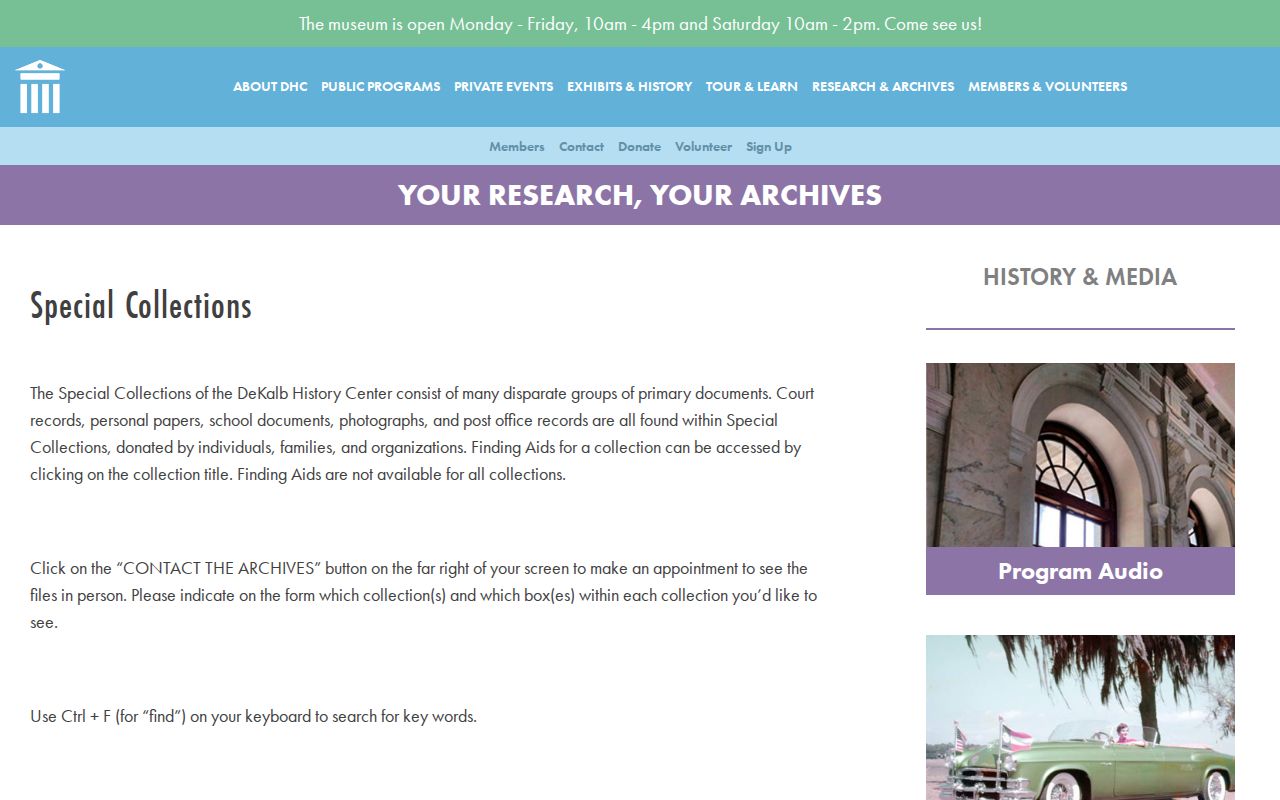
The collection page is a finding aid, not a name search. Identify the collection before making an appointment, ask whether the box is on site, and confirm photography and reproduction rules.
The Center's reference periodicals include city directories and incomplete runs of Smoke Signals, Decatur Focus, Doraville Citizen, Brookhaven Buzz, and The Champion.
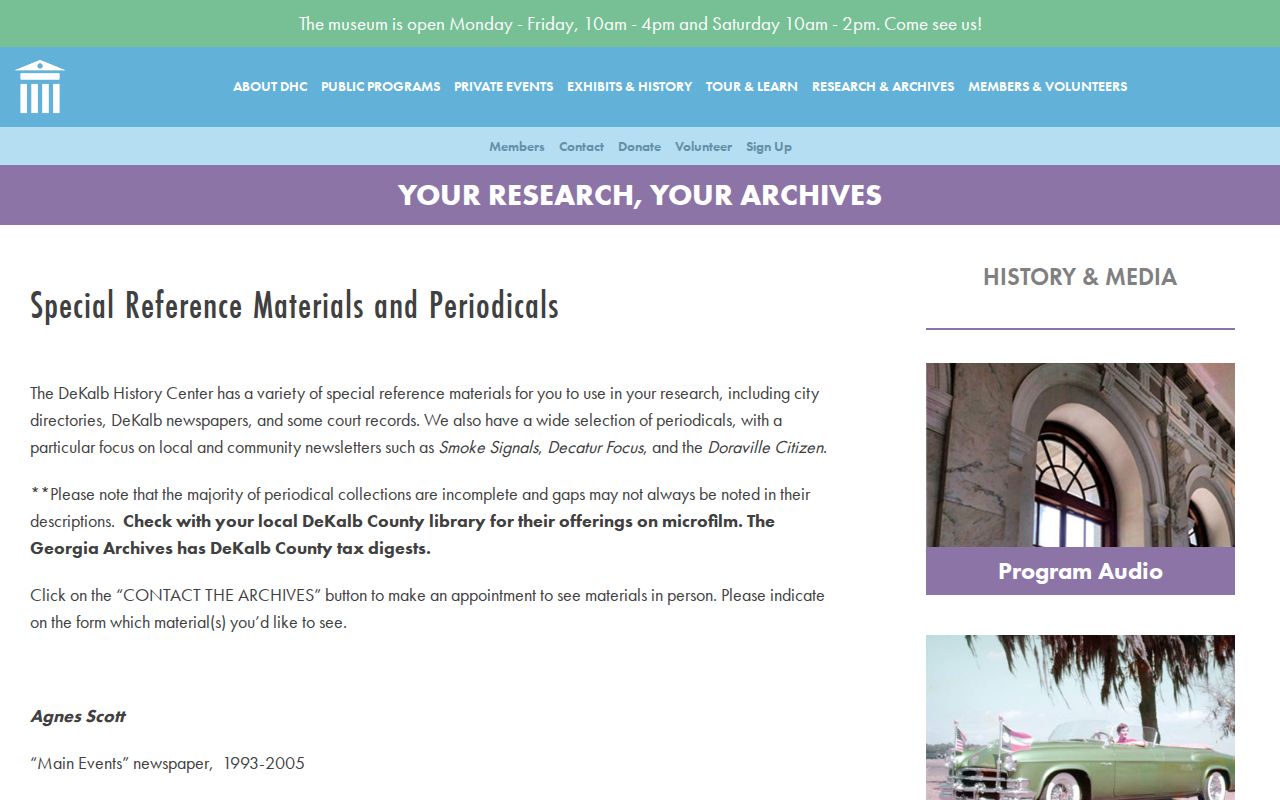
Those periodicals can fill a gap with notices, club news, or community events, but their incomplete runs and uneven coverage should be stated with each citation.
DeKalb Directory Research Timeline
Several dates set the boundaries of a DeKalb County city directory search. They explain why a recent address can be checked fast while an early household needs a mix of books, film, and archive appointments.
| Year | Change in the DeKalb record trail |
|---|---|
| 1822 | DeKalb County was created, with Decatur as county seat. |
| 1928 | Verified Decatur Library city directory holdings begin. |
| 1928-29 | The History Center volume covers Decatur plus Avondale Estates, Emory, and Scottdale. |
| 1950 | The newest federal population census open to the public as of 2026. |
| 1979 | The Clerk's modern Landmark deed index begins its electronic coverage. |
Older deeds and county series may require handwritten indexes or microfilm. The Georgia Archives Virtual Vault offers a free, no-login route into more than 521,000 browsable items across its collections.
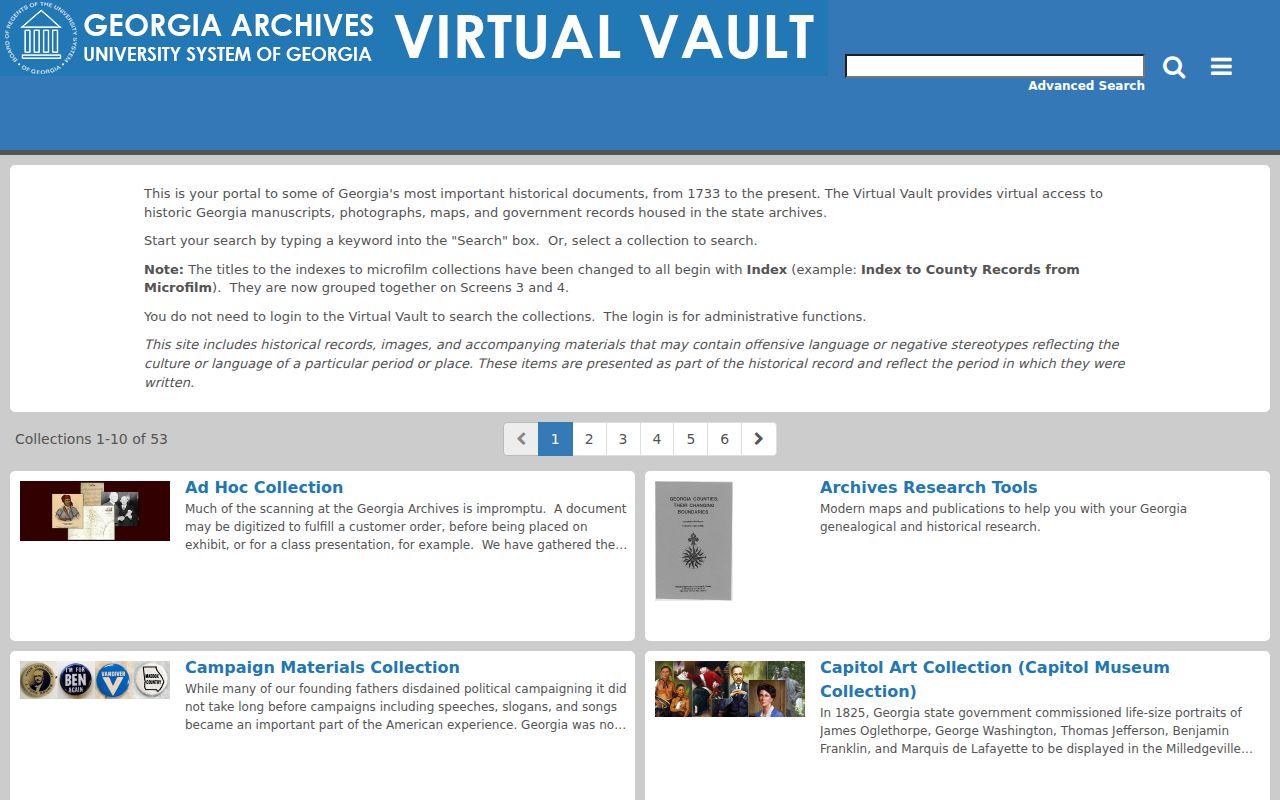
The Virtual Vault does not replace the directory shelf. It supplies names, county cards, and images that can help explain what happened between available volumes.
Trace DeKalb Families by Directory
Follow a household across available city directories one year at a time. Pairing the listing with the 1930, 1940, and 1950 censuses can reveal household members and resolve initials. The public census cutoff is 1950 under the 72-year rule; the 1960 schedule is expected in 2032.
- Start with a known year, name, or address and copy the entry exactly.
- Check the prior and next available volumes for spelling, spouse, occupation, and moves.
- Use the reverse section, if present, to confirm the street number and nearby listings.
- Compare the closest public census using period street names and enumeration geography.
- Use an obituary, probate file, or cemetery record when the listing ends.
A disappearance has several meanings. The resident may have moved, died, become unlisted, or fallen into a missing volume. For a modern address search, use the DeKalb County street directory instead of stretching an old volume past its date.
DeKalb Obituary and Index Links
The library's research databases include HeritageHub obituary and death-notice images along with current and archived Atlanta Journal-Constitution material. HeritageHub coverage reaches from 1704 to the present across participating newspapers, though a library card may be required.

An obituary can connect a city directory name to relatives and a later place. It should be compared with the library's Georgia Death Index, the DeKalb Probate Court, or cemetery material where possible.
The Georgia Archives research help explains the older county-record route through microfilm and FamilySearch.
Before browsing hundreds of images, identify DeKalb County, the court or record series, and any known book or index reference.
DeKalb Directories Reveal Rear Homes
DeKalb History Center research on Sycamore Street shows why city directories work best beside Sanborn maps and city records. Small rear dwellings can be missed by prominent newspaper accounts yet appear through address order, building footprints, or public improvement files. This local story is a useful check on any claim that one publication captured the whole community.
Historic sources also underrepresented many Black residents, working families, immigrants, and people outside influential civic circles. Directories, census schedules, deeds, churches, cemeteries, and neighborhood papers each preserve a different slice. An honest DeKalb County city directory result names the source and its gap.
Institutional and community archives widen the search further. Emory University and Agnes Scott College may hold yearbooks, newspapers, or special collections tied to students and staff. The History Center's Espy IV material includes Decatur churches, civic groups, a realtors association, Smoke Rise, and other mid-century organizations. Forkner Drive Civic Club records begin in 1941 and include a scrapbook, newsletters, and servicemen's letters. These sources document public and historical participation; they should never be treated as a modern private roster.
Negative results need a scope statement. Write that a name was not found in a named volume and year, not that the person never lived in DeKalb County. Keep the spelling variants searched and the date of the search. If a street name changed, retain both forms and use the parcel or legal description as the bridge. That method makes a later correction possible when another volume, census page, or archive box becomes available.